Keeling and Viktor’s all-night U-boat pursuit
The Good ShepherdKeeling and Viktor’s all-night U-boat pursuit is a test of attention and command under conditions where every contact may be misleading and every choice leaves another danger exposed. The destroyers circle through darkness, exchange bearings, and drop depth charges without securing a kill. Their pursuit pushes one submarine away from the convoy, but another attack sets ships burning; Krause must continue the hunt while knowing that the convoy and its crews remain vulnerable. The event ends not with a confirmed destruction, but with an exhausted decision to abandon contact and return to the stragglers.
Conditions Before the Hunt
The chase takes place within a convoy already under strain. Keeling is in Condition Two, a sustained readiness posture that keeps battle stations largely manned and water-tight integrity in force. Calling General Quarters would bring every man to his battle station, halt ordinary ship routines, and leave essential maintenance undone. Hunger and fatigue would accumulate, while repeated alarms without an obvious reason could make men slack in their duties. Krause therefore treats the crew’s capacity for sustained action as a resource to conserve, not an unlimited reserve to spend.
The shortage of trained ratings makes that calculation practical as well as humane. Keeling’s new weapons and instruments require additional hands, but the ship does not have enough trained men to man three watches in Condition Two; even if it did, there would be little room to sleep or capacity to feed them. Krause has divided the company into four sections and set a watch-and-watch routine. He also cancels a routine General Quarters call before dawn: the ship is already alert, and another unnecessary interruption would cut into the watch below’s full four hours of rest. The pursuit is thus conducted by a force whose readiness depends on managing exhaustion as carefully as weapons.
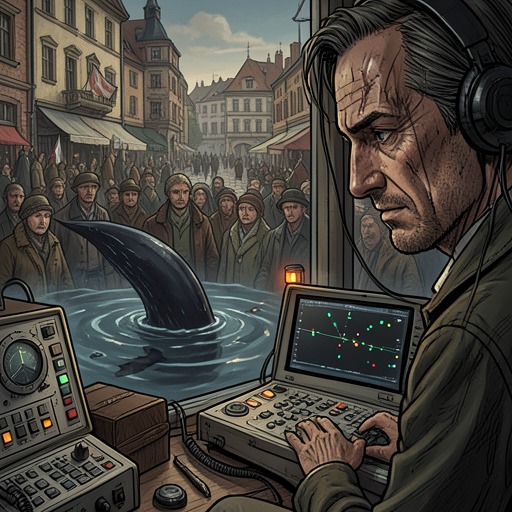
Attention is distributed across the ship, but it is not equally secure at every point. Seven lookouts scan assigned sectors, wiping spray from their binoculars as they search for the brief glimpse of a periscope that could decide the convoy’s fate. Below, Tom Ellis operates sonar. He has spent months listening to pings without ever hearing an echo from a submarine; his training at the Key West Sound School was brief, and he has had no practical refresher. A depth charge dropped within ten yards of a target might mean victory, while one dropped twenty yards away could mean failure. That narrow margin makes the pursuit depend on an operator whose experience in the decisive conditions is untested.
The Pursuit and Its Evasive Turns
The hunt proceeds through intermittent, faint contacts and repeated changes of course. Keeling and Viktor circle after the submarine, dodging each other as they pass in darkness. Viktor at one point heads the U-boat away from the convoy, while Keeling misses it as it circles and Viktor misses it when it doubles back. The ships alternate depth-charge attacks; each detonation rumbles through the night and deafens the sonar, forcing anxious waits before the search can resume. Bearings and courses pass between the escorts, while reports from James and Dodge on the flanks add other engagements to Krause’s calculations.
The submarine’s captain is difficult to pin down. At one point Krause suspects that the U-boat has dropped two Pillenwerfer decoys and sharply changed depth, slipping between the decoys and the searching destroyers. Later, sonar reports a contact that sounds like a pill. The decoy’s bubbles lift it briefly through the water before it sinks, while the possible position of the submarine grows less certain with every passing second. Krause tries to reconstruct the U-boat’s movements from the positions and likely expectations of both commanders, but the maneuver remains a matter of inference rather than sight. When sonar reports no contact, neither Keeling nor Viktor can confirm where the submarine has gone.
The pursuit is physically punishing as well as tactically uncertain. Keeling wallows and corkscrews in the quartering sea; during turns, waves crash over her low freeboard and strike the forecastle. The hunt has already lasted three hours without damaging the submarine, although the destroyers have forced it away from the convoy’s path. Krause reasons that its extensive use of batteries, often at six knots rather than creeping at three or lying still, must be increasing pressure on its commander. But the convoy’s danger remains: drawing Keeling and Viktor to the flank leaves its front open, while James and Dodge are occupied elsewhere. A determined submarine force can probe weaknesses faster than two destroyers and two escort vessels can cover the whole perimeter.
The Convoy Under Attack
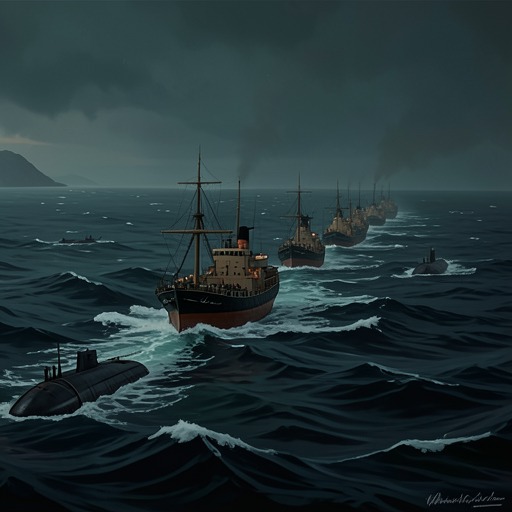
As the pursuit continues, lookouts report fire in the convoy. Krause sees rockets rise above the flames, then a further red glow that silhouettes the upper works of ships. The interval between explosions indicates that this is not one spread of torpedoes striking several targets at once: a U-boat is deliberately attacking ships in succession. The contrast is stark. Keeling and Viktor have kept their quarry away from the convoy, yet the wider formation is being hit while Krause’s attention is fixed on another contact.
Sonar then reports a contact bearing zero-seven-seven. Krause has to choose between remaining with the submarine they have been hunting and turning toward the men dying behind him. He continues the pursuit and orders depth charges away. The decision is presented not as a simple preference for the chase, but as a painful command dilemma: a false move could allow the submarine in contact to escape or attack, while abandoning the hunt would not itself protect the convoy from the vessel already firing on it. The attack makes the limits of the escort force immediate and personal. Krause cannot be everywhere, and acting against one danger means leaving another unopposed for the moment.
Breaking Off
The exchange of reports and course changes continues as Krause works to intercept the elusive submarine. At one point he orders a turn to cross Eagle’s wake after its next attack; later, a new sonar bearing prompts him to turn toward Eagle and intercept. The contact still offers no certainty of a target, and the decoy has already shown how a signal can lead the ships away from the submarine itself. In the darkness, the destroyers must make decisions from bearings, movement, and the changing quality of sonar reports rather than from a visible enemy.
After roughly seven hours, Krause gives up the hunt. He feels regret and self-doubt, though submarine searches have been called off before. The convoy, now visible over the horizon, has straggled during the night’s torpedo attack and is spread out; Viktor must cover the vulnerable flank and help gather the ships back into formation. Krause orders Keeling east to the head of the convoy, with one more sweep before patrolling around the stragglers. Neither ship has regained contact. The ending is therefore a tactical withdrawal rather than a victory: the pursuit has helped divert one U-boat, but it has consumed hours and left the escorts to face the damage and disorder of the convoy’s night attack.
Significance
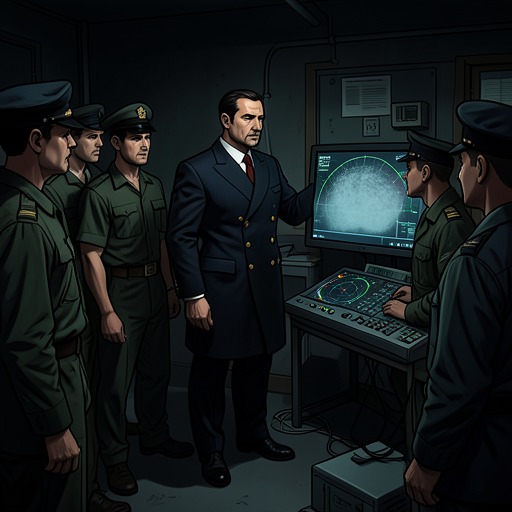
The pursuit makes the convoy battle a problem of competing obligations rather than a single contest between destroyer and submarine. Krause’s force must preserve its men’s stamina, keep watch for brief and easily missed signs, interpret uncertain sonar, coordinate with ships operating on separate flanks, and decide which threat can be addressed now. No single sensor or ship guarantees control. The lookouts’ fleeting visual chance, Ellis’s untested listening, and the disappearing contact each expose a different vulnerability in the chain of detection and response.
The decoy and the scattered convoy give the chase its defining reversal: greater effort does not produce greater certainty, and keeping one enemy from the convoy does not stop another from attacking it. Krause can reason about the U-boat’s batteries and infer its likely turns, but he cannot turn those deductions into a confirmed kill. By the time he returns to the convoy, the immediate task has changed from pursuit to restoring protection around vessels dispersed by the attack. The unresolved ending emphasizes the cost of limited forces and incomplete information: command means acting decisively, then accepting that even a necessary choice may leave danger and failure behind it.